
HANA appeared in 32 of 60 SAP listings for Kolkata when we read them on 2 November 2026. Nobody should treat that as a reason to “learn HANA” first, because such tags often point to S/4HANA, the platform underneath many SAP roles. Searching for the best SAP module to learn tends to produce lists like that, stripped of context. Your background is a much better guide than a popularity count. Here is how to choose, along with a plain explanation of the modules you will meet.
The best SAP module to learn depends on your background
SAP modules map onto real company departments. Learning one is much easier when you already understand the department behind it. An accountant knows why an invoice must match a purchase order, while a new learner has to memorise it.
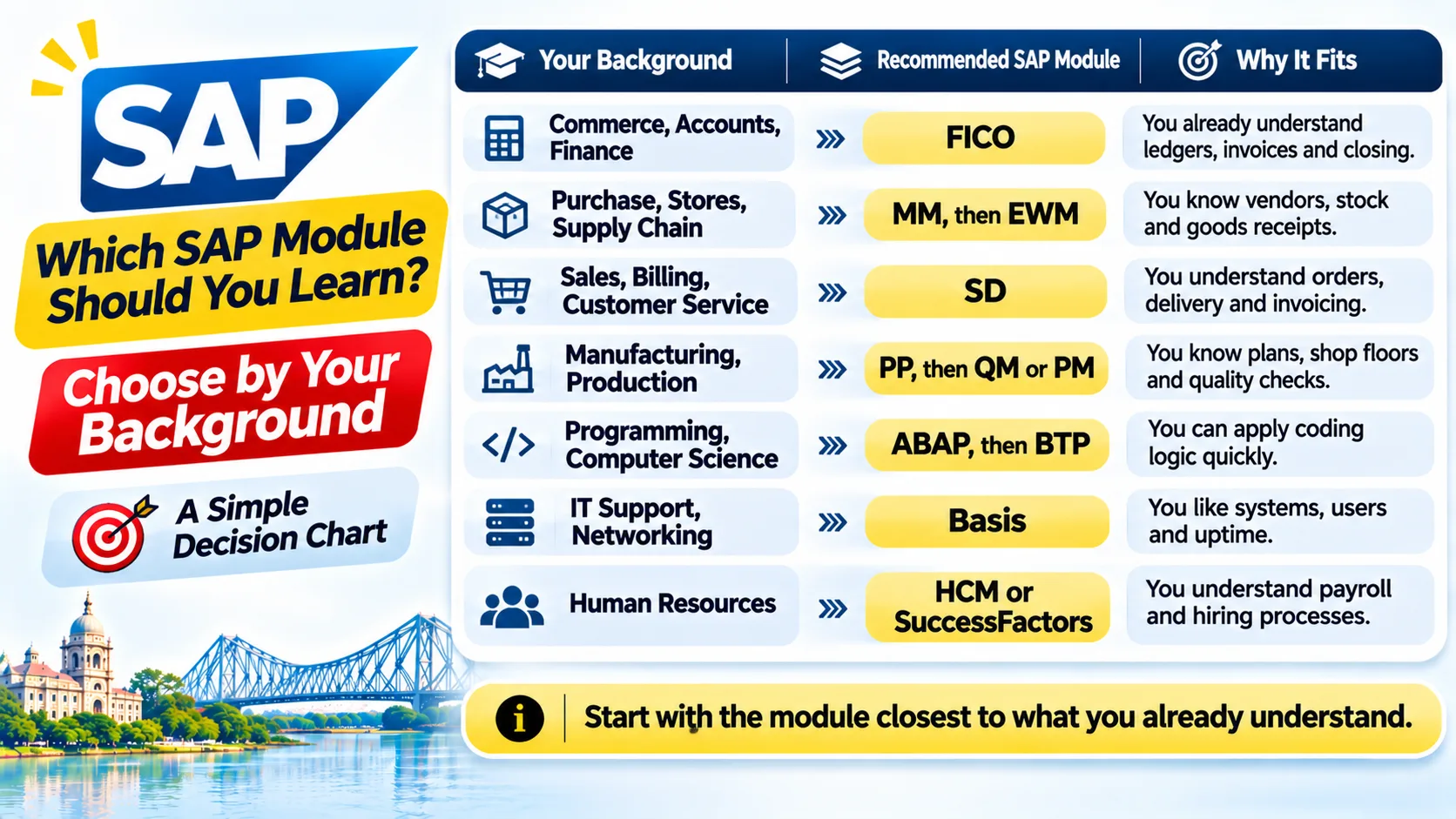
Start with the row closest to your study or work.
| Your background | Start by looking at | Why it fits |
|---|---|---|
| Commerce, accounts, finance | FICO | You already understand ledgers, invoices and closing |
| Purchase, stores, supply chain | MM, then EWM | You know vendors, stock and goods receipts |
| Sales, billing, customer service | SD | You understand orders, delivery and invoicing |
| Manufacturing, production | PP, then QM or PM | You know plans, shop floors and quality checks |
| Programming, computer science | ABAP, then BTP | You can apply coding logic quickly |
| IT support, networking | Basis | You like systems, users and uptime |
| Human resources | HCM or SuccessFactors | You understand payroll and hiring processes |
Nothing stops you from crossing over later. Many consultants add a second module after a few years, usually a neighbouring one. Starting close to your strengths simply makes the first step shorter.
The main modules, in plain words
SAP names can look like alphabet soup. Here is what each one on your likely shortlist does.
Finance and operations modules
→ FICO: Finance and controlling, covering accounts, costs and reports.
→ MM: Materials management, covering purchasing and inventory.
→ SD: Sales and distribution, covering orders, shipping and billing.
→ PP: Production planning, covering what gets made and when.
→ QM: Quality management, covering inspections and quality records.
→ PM: Plant maintenance, covering upkeep of machines and equipment.
→ PS: Project systems, covering budgets and schedules for large projects.
Warehouse, procurement and planning modules
→ EWM: Extended warehouse management, covering detailed warehouse work.
→ Ariba: A cloud tool for buying and supplier management.
→ IBP: Integrated business planning, used for supply chain forecasting.
→ TM: Transportation management, covering freight and delivery planning.
HR and customer modules
→ HCM: Human capital management, covering employees and payroll.
→ SuccessFactors: Cloud HR software for hiring, performance and learning.
→ CRM: Customer relationship management, covering sales and service contacts.
Technical modules
→ ABAP: SAP’s own programming language, used to build custom programs and reports.
→ Basis: System administration, covering installation, users and performance.
→ BTP: SAP’s Business Technology Platform, used to build and connect applications.
→ Fiori: The modern user interface for SAP apps.
→ BW: Business warehouse, used for reporting and analysis.
→ HANA: SAP’s in-memory database, and the base of S/4HANA.
Your course may use slightly different names, so ask what each module covers. Institutes also do not teach all twenty, as our SAP courses comparison shows.
Which modules do Kolkata listings ask for?
Local demand gives you another useful signal, as long as you read it carefully. These are tag counts from 60 Naukri listings for SAP in Kolkata, read on 2 November 2026.
| Tag | Listings out of 60 |
|---|---|
| HANA or S/4HANA | 32 |
| FICO | 5 |
| ABAP | 5 |
| Basis | 5 |
| SD | 4 |
| EWM | 4 |
| PP | 3 |
| HCM | 2 |
| Ariba | 2 |
| BTP | 2 |
| MM | 1 |
| QM | 1 |
Small differences here mean almost nothing. MM showing one tag does not make it a weak choice, because a listing can mention MM in its description without using a tag. Listings also show a capped number of tags, and this sample covers a single day.
Experience is the more useful takeaway. Fifty-seven of those 60 listings wanted at least three years. So your first module should help you get in somewhere, rather than chase a tag count.
Do you need to learn S/4HANA from the start?
S/4HANA is SAP’s current business suite, and FICO, MM or SD are functional areas that run inside it. So you are not choosing between S/4HANA and FICO. You are choosing a functional area, then checking which version the course teaches.
The tag count above suggests that Kolkata employers talk about S/4HANA often. Ask each institute whether its practice system runs S/4HANA, and how much of the syllabus covers it. Graphson Tech and Best Training Kolkata both name S/4HANA on their pages, while others may teach it under a module name.
Which SAP module pays the most?
We could not verify a reliable pay ranking by module for Kolkata. Lists online often name a highest-paying module, but rarely show their data or the experience level behind it. So for a Kolkata fresher, that figure is not publicly disclosed.
Here is what we could verify. AmbitionBox shows SAP consultants in Kolkata at ₹9.7 to 11.3 lakh with 2 to 9 years of experience, from 182 salaries. Some listings on Naukri showed wider ranges at senior levels, such as FICO at 8 to 12 years for ₹15 to 30 lakh.
Those numbers reflect years of project work, so do not expect them after a course. A consultant’s pay usually rises with project experience and business knowledge more than the module name alone.
Should a beginner pick a functional or a technical module?
Functional modules such as FICO and MM focus on business processes. You talk to users, understand their problem and configure the system to fit. People with commerce or operations experience usually settle in here.
Technical modules such as ABAP, Basis and BTP lean on programming or system skills. You build, connect or maintain things that functional consultants request. If you enjoy logic puzzles more than client meetings, start looking here.
A quick test helps when you feel unsure. Try one free self-paced course on SAP Learning, then notice which part held your attention. Liking the work will carry you through the difficult first year better than any salary list.
How modules connect, and why that helps you later
SAP modules share one system, so your work touches other teams constantly. A purchase order in MM eventually reaches accounts in FICO. Sales orders in SD pull stock information that MM maintains.
That link makes a neighbouring module a natural second step. Someone in FICO often picks up controlling or reporting, while an MM consultant might move towards EWM or Ariba. A technical consultant might go from ABAP towards BTP or Fiori.
Knowing these links also makes you stronger in your first module. An interviewer will often ask how your area affects another department. A simple, correct answer tells them that you understand the business and have done more than memorise screens.
Mistakes people make when choosing a module
Beginners tend to repeat the same few errors, so watch for these:
→ Picking a module only because a friend’s cousin earns well in it.
→ Choosing whatever the institute’s counsellor happens to promote that month.
→ Assuming a certificate in a new cloud module replaces real business knowledge.
→ Learning two modules at once before finishing one properly.
→ Expecting to learn SAP in two days from a crash course or a video series.
Our SAP career for freshers guide covers what happens after you choose, including realistic ways in.
Pick one row from the table and try a free course
Pick the module closest to what you already understand, and only then compare courses and institutes. FICO, MM, SD, ABAP and Basis are common starting points, while newer modules usually work better as a second step. Write your background on paper, pick one row from the table above, and try a free SAP Learning course in that area this week.
Frequently asked questions
Q.1 Which SAP module is best for beginners?
No single module suits every beginner. FICO often suits commerce graduates, MM suits purchase or stores backgrounds, SD suits sales roles, and ABAP suits people who already enjoy programming.
Q.2 Which SAP module is highly paid?
We could not verify a reliable module-wise pay ranking for Kolkata. Senior FICO roles on Naukri showed ₹15 to 30 lakh at 8 to 12 years, but that reflects experience more than the module.
Q.3 Which module is in demand in SAP?
HANA or S/4HANA tags led our Kolkata sample with 32 of 60 listings. FICO, ABAP and Basis each had 5, though this is a one-day snapshot with capped tags.
Q.4 Can I learn SAP in 2 days?
No. Two days might introduce the screens and vocabulary, but learning one module properly takes months of hands-on practice and real business examples.
Q.5 What is the SAP modules list for beginners?
The main SAP modules list on the finance and operations side includes SAP FICO, SAP MM, SAP SD, SAP PP, SAP QM, SAP PM and SAP PS. For SAP modules for beginners, start with the one closest to your background, such as FICO for accounts or MM for purchase and stores, and add a neighbouring module later.
Q.6 What do SAP EWM, SAP Ariba, SAP IBP and SAP TM do?
SAP EWM covers detailed warehouse work, SAP Ariba is a cloud tool for buying and supplier management, SAP IBP supports supply chain forecasting, and SAP TM covers freight and delivery planning. They are usually a second step after a core module such as MM.
Q.7 What are SAP HCM, SAP SuccessFactors and SAP CRM used for?
SAP HCM covers employees and payroll, SAP SuccessFactors is cloud HR software for hiring, performance and learning, and SAP CRM covers sales and service contacts. Human resources backgrounds usually start with HCM or SuccessFactors.
Q.8 What do SAP ABAP, SAP Basis, SAP BTP, SAP Fiori, SAP BW and SAP HANA mean?
SAP ABAP is SAP’s own programming language for custom programs and reports, SAP Basis covers system administration, and SAP BTP is used to build and connect applications. SAP Fiori is the modern user interface, SAP BW is used for reporting and analysis, and SAP HANA is the in-memory database that underlies S/4HANA. HANA tags often point to S/4HANA, so they are not a reason to learn HANA first.
Q.9 Are SAP certification courses worth it for a beginner?
SAP certification courses can add structure, but a certificate does not replace real business knowledge or project experience. Choose your module by background first, try a free course on SAP Learning, then compare institutes and ask which modules and which version, such as S/4HANA, they actually teach.
Q.10 What is the best SAP module to learn for a first job in Kolkata?
It depends on your background, so start with the row of the table closest to your study or work. Fifty-seven of the 60 Kolkata listings we read wanted at least three years, so your first module should help you get in somewhere, not chase a tag count.
Sources
→ Naukri, SAP jobs in Kolkata, read 2 Nov 2026
→ AmbitionBox, SAP consultant salary in Kolkata

I am Ance John, a Content Writer with 6 years of experience in creating informative, engaging, and SEO-friendly content. I specialize in career guidance, education, professional development, digital marketing, and industry trends. My goal is to simplify complex topics and provide valuable insights that help students, freshers, and working professionals make informed career decisions. Through my content at Kolkata Skills, I focus on institute guides, career roadmaps, skill development, and educational opportunities in Kolkata.