
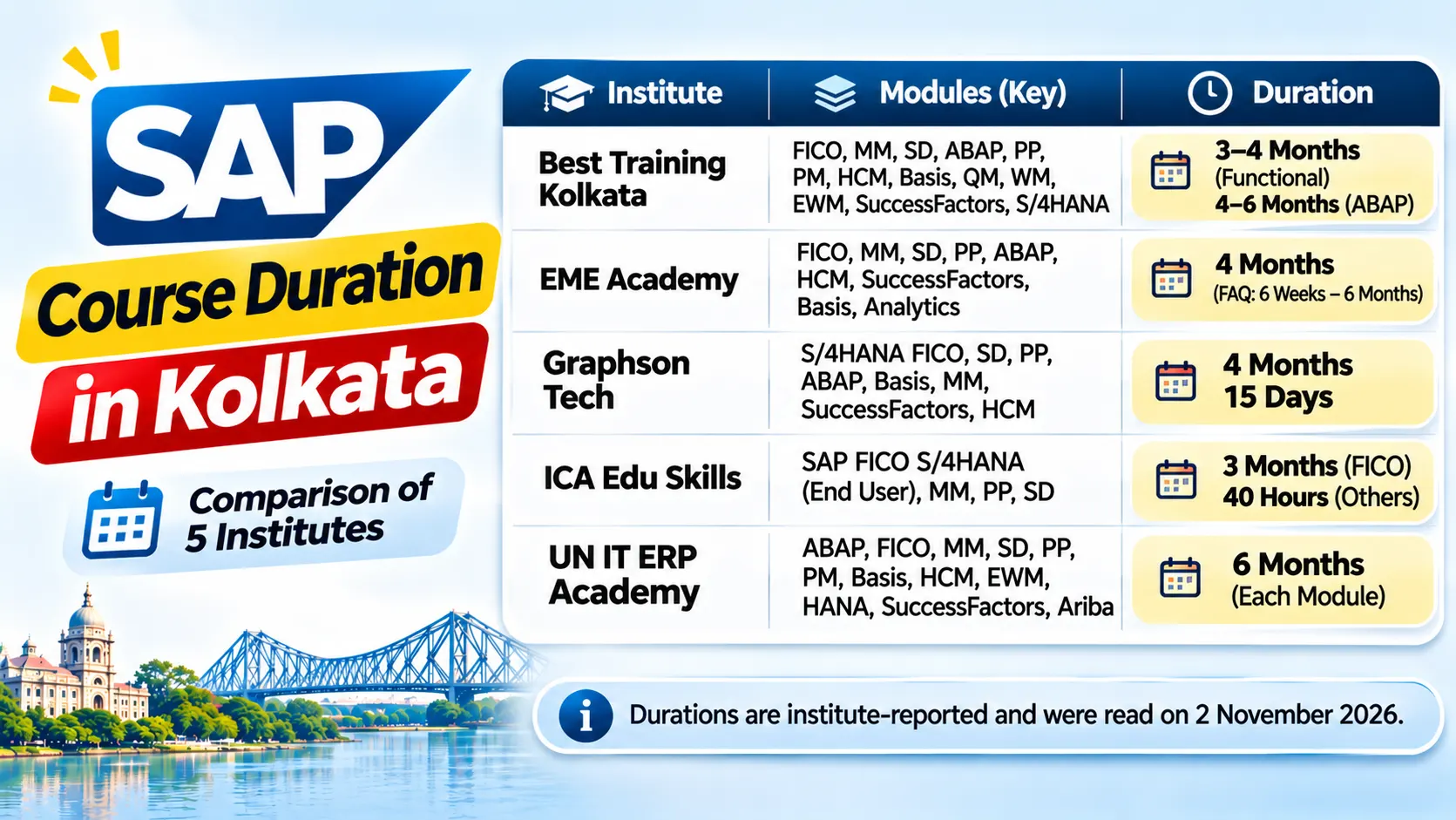
Published SAP FICO courses in Kolkata run from three months at ICA Edu Skills to six months at UN IT ERP Academy. That gap matters more to a beginner than any “best” label. The best SAP courses in Kolkata for one student can suit another person badly, since background and budget change the answer. We read five institute websites on 2 November 2026 and compared what each one published. Fees, modules and hours are below, along with what a beginner should realistically expect to learn.
How the best SAP courses in Kolkata compare on paper
Details differ a lot between institutes, so a simple table helps. Everything here comes from each institute’s own website, and the order is alphabetical, not a ranking.
| Institute | Modules listed | Duration | Fee | Mode |
|---|---|---|---|---|
| Best Training Kolkata | FICO, MM, SD, ABAP, PP, PM, PS, HCM, Basis, QM, WM, EWM, SuccessFactors, S/4HANA | Functional 3 to 4 months, ABAP 4 to 6 | Around ₹25,000 per module | Classroom, online |
| EME Academy | FICO, MM, SD, PP, ABAP, HCM, SuccessFactors, Basis, Analytics | 4 months each, FAQ says 6 weeks to 6 months | ₹35,000 on homepage | Classroom, online |
| Graphson Tech | S/4HANA FICO, SD, PP, ABAP and Basis, MM, SuccessFactors and HCM | 4 months 15 days | Not publicly disclosed | Classroom, online |
| ICA Edu Skills | SAP FICO S/4HANA End User, MM, PP, SD | FICO 3 months, others 40 hours | Not publicly disclosed | Not recorded |
| UN IT ERP Academy | ABAP, FICO, MM, SD, PP, PM, Basis, HCM, EWM, HANA, SuccessFactors, Ariba, QM | 6 months each | Not publicly disclosed | Classroom, some online |
Google also showed CloudLearn ERP at 4.7 from 163 reviews in its local results. We did not read that institute’s course page, so its fee and duration are not listed here. Ask every institute for the exact syllabus and fee, because websites can lag behind current batches.
Which course length makes sense for a beginner?
Longer does not automatically mean better. A 40-hour course can introduce one module’s main transactions, but it leaves little time for mistakes and repetition. Six months gives more practice, though only if the extra hours go to hands-on work.
ICA’s End User label deserves a closer look. An end user runs daily transactions inside a company, while a consultant configures the system for a business. Those are different levels of skill, so check which one your course aims at.
Ask for an hour-by-hour split before you compare durations:
→ How many hours go to live trainer sessions?
→ How many hours do you spend practising inside the system?
→ How many case studies or end-to-end scenarios do you complete?
→ Does the course end with a project that someone reviews?
Total duration only means something once you know those numbers. Two courses with the same length can give you very different amounts of practice.
Can you really learn SAP in three months?
You can learn the basics of one module in three months if you practise regularly. Someone with accounts experience can follow a finance process in FICO quite quickly, because the business logic already feels familiar.
Becoming job-ready as a consultant takes much longer. Real projects involve messy data, unusual client rules and problems no classroom covers. Treat a three-month course as a strong start, then plan what comes after it.
Self-paced study can fill some gaps cheaply. The SAP Learning site offers free self-paced courses and Learning Journeys, while its premium practice needs a paid SAP Learning Hub subscription. Trying a free course first also tells you whether you enjoy this kind of work.
Which module suits a fresher?
Your degree and any work experience should guide this choice. A commerce graduate usually picks up SAP FICO faster than someone who has never seen a balance sheet. An engineering graduate who enjoys coding may find ABAP a better fit.
→ SAP FICO course in Kolkata: This suits commerce graduates, and every institute we read lists it.
→ SAP MM course in Kolkata: This suits people interested in purchasing, stores and inventory.
→ SAP SD: This suits people who understand sales orders, delivery and billing.
→ ABAP: This suits anyone comfortable with programming logic.
Our separate guide explains the best SAP module to learn with a fuller decision table. We would avoid paying for a module just because someone says it pays the most.
What will a beginner actually learn in the first month?
Course pages rarely explain this, so here is a typical picture from general SAP practice. Details differ by institute, so ask for the actual plan.
Early classes usually cover SAP navigation and what an ERP system does. You learn how a company’s departments share one system, so a purchase entry can later affect accounts. Those links explain why SAP skills are valued in large businesses.
Next, you work through one simple end-to-end process. In MM, that might mean creating a purchase request, then an order, then recording goods received. A FICO learner might post an invoice and see how it reaches the accounts.
Configuration usually comes after you understand the process. That is the stage where you start setting up the system rather than only using it, and it is where weak trainers get exposed.
What about certification and fees?
An SAP certification exam is separate from any institute certificate. The SAP Learning site listed 99 certifications when we checked on 2 November 2026. We could not confirm an official exam fee for India, so verify it there before you budget.
Institute certificates vary from one place to the next. Graphson Tech issues its own, ICA mentions an ICA and NSDC certificate, and UN IT ERP Academy states it is not certified by SAP. None of that stops you from learning well, but you should know exactly what the paper represents.
When you compare SAP course fees in Kolkata, ask these before you decide:
1. Does the fee cover one module or several?
2. Are GST and server access included in that amount?
3. Does the fee include any SAP exam, or only the institute’s certificate?
Is SAP better than an MBA?
Searchers ask this often, but the two do different jobs. An MBA is a broad management degree, while SAP training teaches a specific business software skill. One can support the other, since many SAP consultants have finance or operations backgrounds.
Pick SAP training when you already know which business function interests you and want a practical skill. An MBA makes more sense if you want general management roles and can afford the time. We have no verified data showing either one earns more in Kolkata, so that answer stays not publicly disclosed.
How to compare two courses that teach the same module
Imagine two institutes both offering SAP FICO. One runs for three months and the other for six. Before assuming the longer one is better, put these details side by side on one page:
→ Total live hours with a trainer, rather than the number of months.
→ Hours you spend alone inside the system, and how long access lasts.
→ Whether the course follows S/4HANA or an older version.
→ The number of full scenarios you complete, such as a month-end closing.
→ The final amount you pay, including GST and any exam.
A short course with heavy practice may beat a long one that moves slowly. Then again, a long course may win if it gives you more scenarios and better feedback. Only these numbers can tell you which is true.
What should you do after the course ends?
Finishing a course is where the harder part begins. Keep practising while your system access lasts, because SAP skills fade quickly without use. Write down each process you learned, in your own words, and use those notes before interviews.
Then look for roles close to your module rather than only consultant posts. A FICO learner can apply for accounts jobs in companies that use SAP, and an MM learner can look at purchase or stores roles. Our SAP career for freshers guide explains why that route often works better.
Ask two institutes for their hour-by-hour plan
The right beginner course matches your background, gives you real system hours and states its fee clearly. Duration and module lists only tell part of that story. Shortlist two courses from the table, ask each for its hour-by-hour plan, and choose the one that gives you more hands-on practice. Our how to choose an SAP institute guide has the full question list.
Frequently asked questions
Q.1 What are the fees for SAP training in Kolkata?
Best Training Kolkata shows around ₹25,000 per module and EME Academy’s homepage shows ₹35,000. Graphson Tech, ICA and UN IT ERP Academy did not publish a clear fee on the pages we read.
Q.2 Which SAP course is best for beginners?
FICO often suits commerce graduates, MM suits purchase or stores backgrounds, and ABAP suits people who like coding. Pick the module closest to what you already understand.
Q.3 Can we learn SAP in 3 months?
You can learn the basics of one module in three months with steady practice. Reaching consultant-level skill takes longer, and most Kolkata SAP listings we read asked for several years of experience.
Q.4 Are there free SAP courses?
Yes, SAP Learning offers free self-paced courses and Learning Journeys. Some hands-on practice needs a paid SAP Learning Hub subscription, so check what each course includes.
Sources
- Best Training Kolkata
- EME Academy, SAP training
- Graphson Tech
- ICA Edu Skills, SAP course in Kolkata
- UN IT ERP Academy
- SAP Learning

I am Ance John, a Content Writer with 6 years of experience in creating informative, engaging, and SEO-friendly content. I specialize in career guidance, education, professional development, digital marketing, and industry trends. My goal is to simplify complex topics and provide valuable insights that help students, freshers, and working professionals make informed career decisions. Through my content at Kolkata Skills, I focus on institute guides, career roadmaps, skill development, and educational opportunities in Kolkata.