If you search for the best data analytics courses in Kolkata, you will find dozens of institutes. Almost every one calls itself the best, and almost every one mentions placement. For a beginner, that makes the choice harder, not easier. Most course pages list the same tools (Excel, SQL, Power BI and Python), yet they differ a lot in fees, format, depth and what “placement support” actually includes.
This guide will not tell you which institute to join. It explains what a beginner course should cover, sets out the published details of eight Kolkata institutes side by side, and gives you the questions to ask before you pay. Every fee and course detail here was taken from the institute’s own website on 13 October 2026. Fees and offers change often, so use them as a starting point and confirm the current figures before you enrol.
What is data analytics, and can a beginner learn it?
Data analytics means collecting, cleaning and examining data to answer practical questions. A retail company might want to know which products sell best in which months. A bank might want to know why some customers close their accounts. A data analyst pulls the relevant data, usually from a spreadsheet or database, cleans it, looks for patterns and presents the findings in a report or dashboard that a manager can act on.
Most entry-level programmes are designed for beginners. Several Kolkata institutes state on their course pages that no coding background is needed, and Google’s Data Analytics Certificate says that no experience or degree is required. What you do need is comfort with basic arithmetic (percentages, averages and ratios), the patience to practise regularly and curiosity about why numbers change.
Do you need maths or coding?
Maths: School-level arithmetic is enough to start. You will also use basic statistics, such as the mean, median, spread and correlation, but most courses compared here teach statistics as part of the syllabus.
Coding: Excel and Power BI need no programming. SQL uses a small set of English-like commands (SELECT, WHERE, GROUP BY), which makes it easier to pick up than a general programming language. Python is the only full programming language in a typical beginner syllabus, and most courses teach it after spreadsheets and SQL.
Data analytics or data science?
Data analytics focuses on describing what happened and why, using data a business already has. Data science goes further into prediction and machine learning, with more programming and mathematics. If you are unsure, analytics is the gentler starting point. Many analytics courses now include an introduction to machine learning, and you can move on to a data science course later if you enjoy it.
What should a beginner look for in a data analytics course?
Course pages tend to highlight the same things: tools, hours and placement. Use this checklist to look past the headline and compare the parts that affect your learning.
- A logical order of tools. Spreadsheets first, then SQL, then a dashboard tool such as Power BI or Tableau, and Python after that. A course that starts with machine learning is probably not designed for beginners.
- Statistics taught through examples. You should learn averages, distributions and correlation by applying them to a dataset, not only through formulas.
- Projects you build yourself. Ask how many projects are included, what data they use and whether a trainer reviews your work.
- Enough practice time. The certificate courses compared below that publish their hours list between 154 and 200+ learning hours. Find out how much of that is live teaching and how much is self-study.
- Trainer access. Check whether you can ask questions between classes, how doubts are handled and who the trainers are.
- Recordings and missed classes. If you work or study alongside the course, ask whether sessions are recorded and whether you can join a later batch.
- Written terms for placement support. “100% placement assistance” usually means help with your CV and interviews, not a guaranteed job. Ask what is included and who is eligible.
- A clear fee and refund policy. Ask whether the quoted fee includes GST, certification charges and EMI costs, and get the refund policy in writing.
Data analytics courses in Kolkata compared
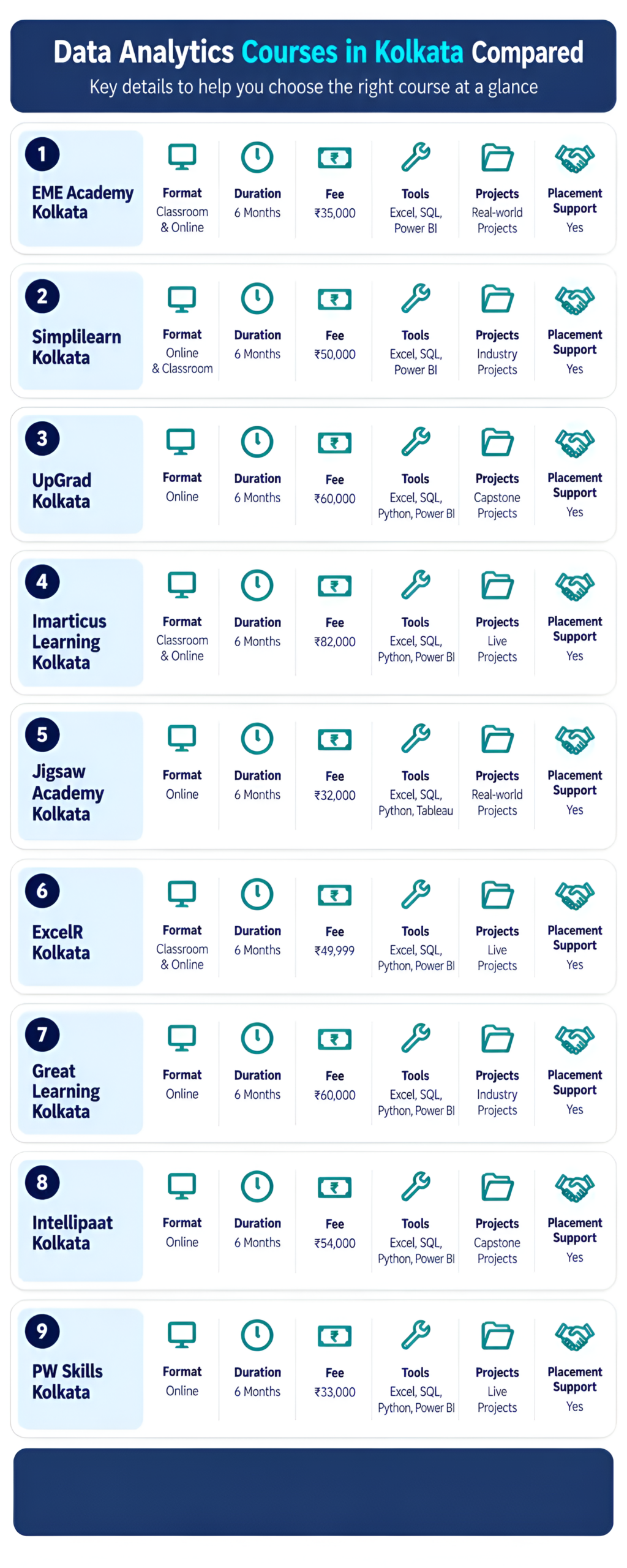
The tables below summarise the published details of nine courses from eight institutes. Institutes are listed in alphabetical order. The list is not a ranking.
How we chose and checked these courses
We included institutes that appeared on the first two pages of Google, or in Google’s local business results, for the search “best data analytics courses in kolkata” on 13 October 2026. We added St. Xavier’s College because its postgraduate diploma also appears on page one and represents a different route: a one-year, university-linked diploma for graduates. We then read each official course page and recorded only what the institute itself publishes. Where a detail was missing, the table says so. We did not visit the institutes, attend classes or contact their admissions teams.
Format, duration, fees and eligibility
| Institute and course | Format | Duration | Published fee (13 Oct 2026) | Eligibility (as stated) |
|---|---|---|---|---|
| DataMites: Certified Data Analyst Course | Classroom, live online or blended | 6 months; 200+ learning hours | Offer prices: ₹69,980 classroom, ₹64,191 live online, ₹40,401 blended (offer stated as valid to 18 Oct 2026) | Open to all backgrounds |
| DataSpace Academy: Certification in Data Analytics With AI | Online and offline | 6 months | ₹40,000 (listed price ₹65,000) | Technical and non-technical backgrounds |
| EME Academy: Data Analytics Course | Online and classroom; recorded classes; evening and weekend batches | 6 months | ₹35,000 (listed price ₹45,000); EMI available | No prior experience required |
| EME Academy: Data Analytics with AI | Online and offline; live classes | 6 months | ₹75,000 (listed price ₹85,000) | Not stated |
| ExcelR: AI Powered Data Analyst Course | Classroom and live online; sessions recorded | 6 months; 190+ hours | Not published (enquiry form only) | No prerequisites |
| Ivy Professional School: Data Analytics With Visualization | Not stated on the course page; centre on Camac Street | 160 hours | Not shown on the course page; contact the institute | Freshers, graduates and working professionals |
| Karmick Institute: Data Analytics Course with Gen AI (TechMaster / TechMaster Pro) | Online, offline or hybrid | 6 months | ₹54,000 / ₹62,000 paid at once; ₹65,000 / ₹78,000 through 3 EMIs | Class 12 pass |
| St. Xavier’s College (Autonomous) with FinX Institute: Postgraduate Diploma in Data Science & Analytics | Hybrid: weekday classes online, Saturday classes on campus | 1 year (two semesters) | ₹95,000 plus ₹600 registration | Graduates in any discipline |
| Webskitters Academy: Data Analytics Course | Online or hybrid | 3–5 months; 154 curriculum hours | Three plans: ₹39,999, ₹64,999 or ₹1,07,000 (offer prices) | No coding background needed |
Tools, projects, placement support and certificates
| Institute and course | Tools listed | Projects and internship (as stated) | Placement support (as stated) | Certificate |
|---|---|---|---|---|
| DataMites | Excel, MySQL, MongoDB, Tableau, Power BI, Python, R, PySpark, Git | 10 capstone projects and 1 client project with an internship certificate | Placement team helps with job connect, CV and mock interviews; FAQ says it does not promise a job | IABAC certification |
| DataSpace Academy | Excel, SQL (MySQL), Power BI, Tableau, Python, statistics | Domain-based capstone projects; an exam after each module | “100% placement support”; internship and placement help “based on the merit of the student” | DataSpace Academy certificate |
| EME Academy: Data Analytics Course | Excel, MySQL, business statistics, Power BI, Tableau, Python, ChatGPT and LLMs, SAS (self-paced) | Live and capstone projects; 1-month internship | “100% placement assistance”: CV and LinkedIn help, aptitude training, mock interviews, counselling | Completion certificate; issuing body not named |
| EME Academy: Data Analytics with AI | Excel, SQL/MySQL, Power BI, Python, Tableau, AI tools, statistics, SAS | 15+ projects; internship certificate | “100% placement assistance”; interview referrals for eligible candidates | Internship certificate stated; course certificate issuer not named |
| ExcelR | Excel (including VBA), MySQL, Tableau, Power BI, Python, R basics, SAS (self-paced), AI assistants | 20+ capstone projects and 30+ assignments | Placement cell and interview preparation; no placement rate claimed | ExcelR certificate; optional IIT-linked add-on (check whether it is included in the fee) |
| Ivy Professional School | Excel, SQL, Power BI, Tableau, Python, business statistics | 3 named projects (Excel, Tableau and SQL) | States a 94% placement rate for full-time programme graduates; job guarantee for “eligible students” (terms not shown) | Ivy Professional School |
| Karmick Institute | Excel, Power Query, statistics, SQL, PostgreSQL, Python, Tableau, Power BI, R, Gen AI | Capstone projects; 100+ problems and assessments | “100% placement assistance”; 50+ mock interviews (TechMaster) | Karmick (TechMaster); Vishlesan i-Hub, IIT Patna (TechMaster Pro) |
| St. Xavier’s College | Big data (cloud, Spark, Kafka), statistics, data visualisation, machine learning, generative AI | Case studies; assignments count for 20% of marks | Not stated on the programme page | Diploma issued jointly by St. Xavier’s College and FinX Institute |
| Webskitters Academy | Excel, Power Query, Power Pivot, Power BI, Tableau, SQL, Python | HR, sales and finance dashboards; portfolio projects in higher plans | Placement assistance in the two higher plans, not in the entry plan | Course completion certificate |
Reading the tables: “As stated” means the wording comes from the institute’s own page. We have not independently verified placement figures, ratings or how widely a certificate is recognised. If something matters to your decision, ask the institute to confirm it in writing.
EME Academy: what its data analytics courses include
EME Academy, based in Salt Lake Sector V, lists two data analytics programmes on its website. Both run for six months, are offered online and in the classroom, and are taught in Bengali, English and Hindi.
- Data Analytics Course (₹35,000; listed price ₹45,000). The syllabus moves from an introduction to data analytics through Excel and SQL, Python, Power BI and Tableau, statistics and predictive analytics, machine learning basics and data cleaning. The course FAQ mentions projects on sales forecasting, customer segmentation and financial data analysis, plus a one-month internship.
- Data Analytics with AI (₹75,000; listed price ₹85,000). This programme covers Excel, SQL/MySQL, Power BI, Python and Tableau as separate learning tracks and adds AI tools. The page lists 15+ real-world projects and an internship certificate.
The standard course FAQ says classes are recorded so you can catch up on a missed session, and that evening and weekend batches are available for working professionals. A free demo class is offered before enrolment.
Who it may suit: learners on a tighter budget who want classroom teaching in Kolkata, learners who prefer teaching in Bengali or Hindi alongside English, and working professionals who need evening or weekend batches.
What to confirm before enrolling: which of the two programmes fits your goals, who issues the completion certificate, how the internship is arranged and what the placement assistance includes for your batch. You can check past learners’ certificates on EME Academy’s certificate verification page.
Which tools should a beginner learn first?
Most of the courses above teach the same core tools in roughly the same order. That order exists for a reason: each tool builds on the one before it.
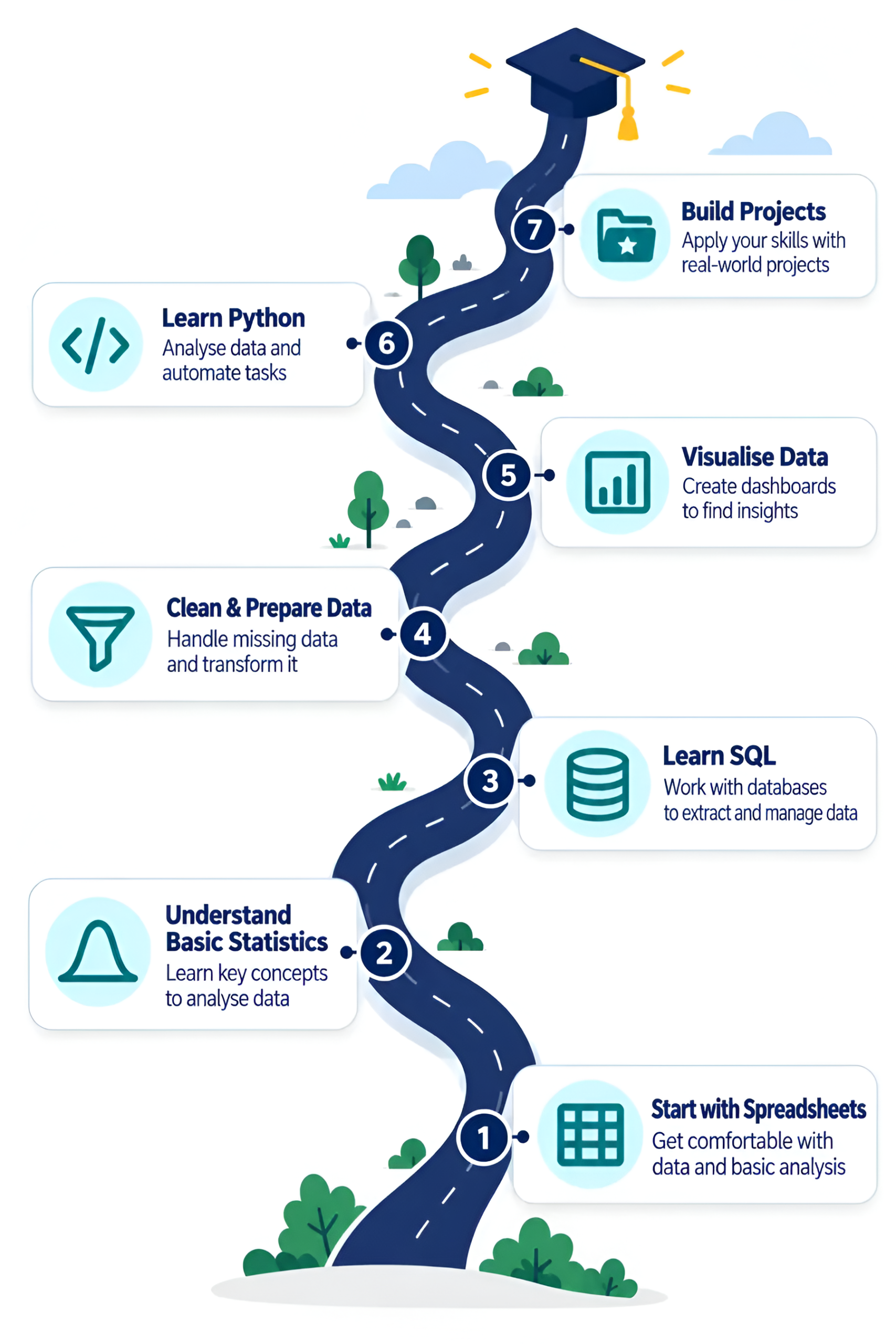
- Spreadsheets (Excel or Google Sheets). Sorting, filtering, formulas, lookups and pivot tables. Spreadsheets teach you how data is structured, and they remain a daily tool in most offices.
- Basic statistics. Averages, spread, distributions and correlation. These help you judge whether a pattern is meaningful or just noise.
- SQL. The language used to pull data from databases. You will learn to select, filter, join and summarise tables.
- Data cleaning. Fixing duplicates, missing values and inconsistent formats. Real datasets are rarely clean, and this step often takes longer than the analysis itself.
- Power BI or Tableau. Turning cleaned data into dashboards. Microsoft’s PL-300 Power BI Data Analyst exam divides the job into four areas: preparing data, modelling it, visualising and analysing it, and managing and securing reports. That is a useful map of what a Power BI module should cover.
- Python, if your goals need it. Python, with libraries such as Pandas, helps you handle larger datasets and automate repeated work. It matters more if you want to move towards data science later.
- Projects and a portfolio. Two or three complete projects, each with a clear question, cleaned data, analysis and a dashboard, show employers what you can do.
Power BI or Tableau? Learn one well before you add the other. Most courses in our comparison teach both. If you are unsure which to start with, read 15 to 20 entry-level analyst job listings in Kolkata and note which tool appears more often. Our article on the career benefits of learning Power BI explains that tool in more detail.
What about AI tools? Several courses now include ChatGPT, Copilot or similar assistants. They can help you write formulas and SQL queries faster, but you still need to understand the logic to check whether the answer is correct.
Online, classroom or hybrid: which format suits you?
Many Kolkata institutes now offer more than one format, sometimes at different prices. DataMites, for example, lists its classroom course at ₹69,980 and its blended option at ₹40,401. The right choice depends on how you learn and how much time you have.
| Factor | Classroom | Live online | Recorded or blended |
|---|---|---|---|
| Schedule | Fixed times; travel to the centre | Fixed times, from home | Study at your own pace |
| Interaction | Face-to-face doubt solving and peer learning | Live questions; depends on batch size | Limited; usually through scheduled mentor sessions |
| Self-discipline needed | Lower, because the routine is set for you | Medium | High |
| Often suits | Learners who want structure and in-person support | Working professionals and learners far from the centre | Self-motivated learners on a tighter budget |
| Ask about | Batch size, lab access, centre timings | Recordings, doubt sessions, how questions are handled | Mentor access, deadlines, how long access lasts |
Data analytics course fees and duration in Kolkata
Among the courses we checked, published fees for certificate courses ranged from ₹35,000 to ₹1,07,000. The one-year university-linked diploma costs ₹95,000. Here is how the published fees group together:
| Published fee range | Courses in this range (published price, 13 Oct 2026) |
|---|---|
| Under ₹45,000 | EME Academy Data Analytics Course (₹35,000); Webskitters Launchpad plan (₹39,999); DataSpace Academy (₹40,000); DataMites blended (₹40,401) |
| ₹45,000 to ₹80,000 | Karmick TechMaster (₹54,000) and TechMaster Pro (₹62,000), paid at once; DataMites live online (₹64,191) and classroom (₹69,980); Webskitters Career Accelerator (₹64,999); EME Academy Data Analytics with AI (₹75,000) |
| Above ₹80,000 | St. Xavier’s PG Diploma (₹95,000 plus ₹600 registration); Webskitters Elite plan (₹1,07,000) |
| Not published | ExcelR; Ivy Professional School |
Free and low-cost options also exist. Microsoft Learn offers free, self-paced Power BI learning paths, and Google says many learners complete its Data Analytics Certificate on Coursera in three to six months at under 10 hours a week. These suit self-motivated learners, or anyone who wants to test their interest before paying for a mentored course.
What to check in the fee
- GST and extra charges. St. Xavier’s lists a ₹600 registration fee separately. Ask every institute whether GST, exam and certificate charges are included.
- EMI versus paying at once. At Karmick, the TechMaster course costs ₹54,000 paid at once or ₹65,000 through three EMIs. Compare the total you will actually pay.
- Offer deadlines. Many prices are shown as limited-time discounts. Do not let a countdown timer rush your decision.
- Refund policy. DataMites, for example, publishes the conditions for a full refund in the first week of the course. Ask every institute for its refund policy in writing before you pay.
How long does it take?
Most certificate courses here run for three to six months. The St. Xavier’s diploma takes one year. Course length matters less than practice time: a six-month course with two short classes a week can give you fewer hours of practice than a three-month course with daily sessions. Ask for the total number of live teaching hours and the expected self-study time each week.
How to check projects, certificates and placement claims
Projects
- Ask to see a sample project from a previous batch.
- Check whether you will work on your own copy of the dataset or only watch the trainer solve it.
- Ask whether a trainer reviews your project and gives feedback.
- Make sure you can share the finished work on GitHub or LinkedIn as part of your portfolio.
Certificates
A course certificate shows that you completed the course. It is not a formal qualification on its own, so ask who issues it. Some institutes add a certificate from a partner institution, but it may apply only to a higher-priced plan (Karmick’s IIT Patna certificate is for TechMaster Pro) or be an optional add-on (ExcelR’s IIT-linked programme). Industry exams such as Microsoft’s PL-300 are separate from any course and are assessed by Microsoft, and Microsoft associate certifications must be renewed every year through a free online assessment.
Placement support
Placement claims need the most care. “100% placement assistance” usually means the institute will help with your CV, mock interviews and job referrals. It does not mean a guaranteed job. Some institutes say this openly: DataMites’ FAQ, for instance, states that its placement team does not promise a job.
Ask these questions, and request the answers in writing:
- How many learners from the last two batches of this specific course were placed, out of how many who enrolled?
- Are the placement numbers for this course, or for the whole institute across all courses?
- What roles and salary ranges did those learners get?
- What must I do to be eligible for placement support, such as minimum attendance, assessments or project completion?
- How many interviews can I expect to be referred to, and for how long after the course?
- If there is a job guarantee, what exactly is refunded, and under what conditions?
You can also search LinkedIn for people who list the course on their profile and ask them about their experience.
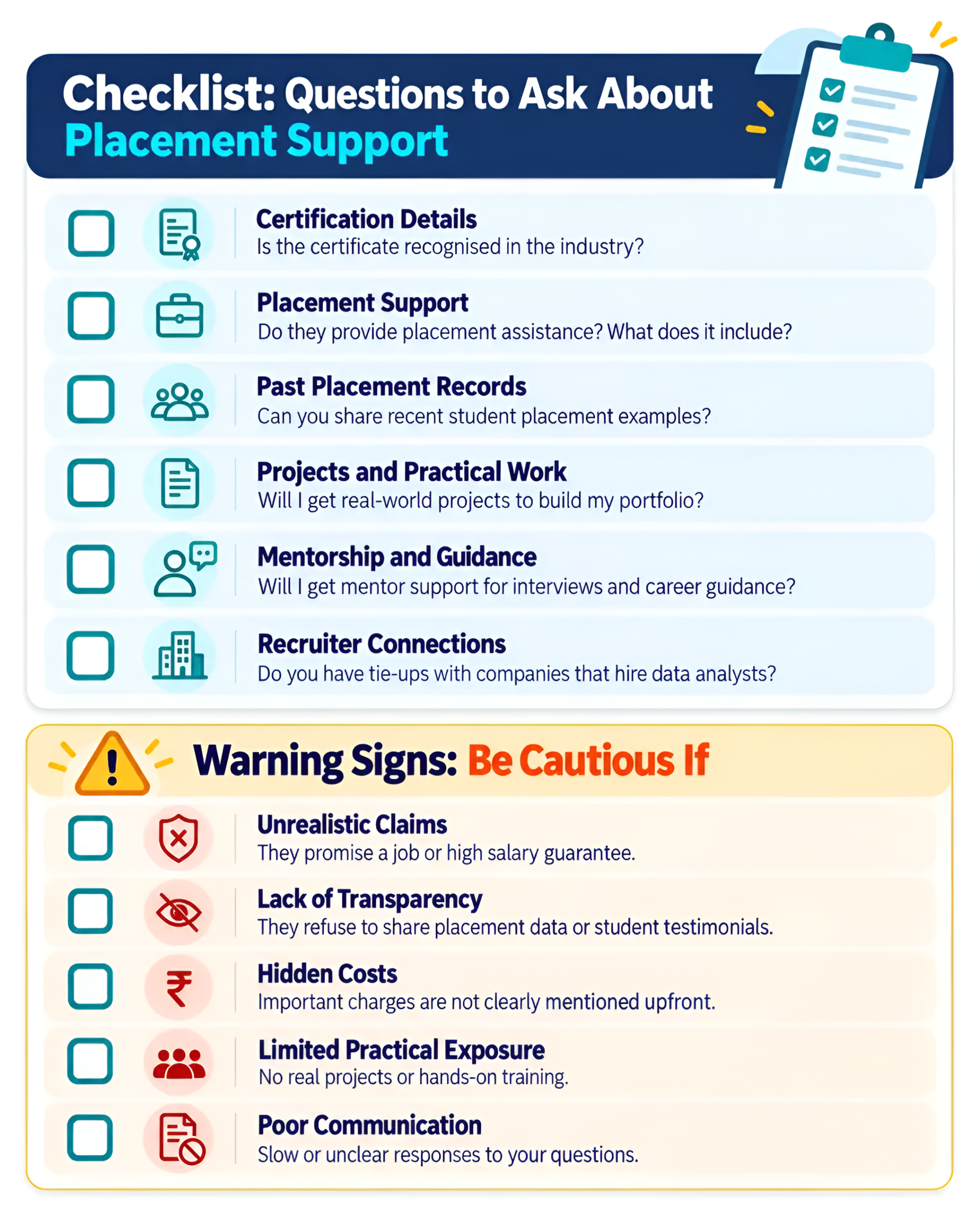
Warning signs
- Pressure to pay a deposit the same day.
- Specific salary promises for beginners.
- Institute-wide placement numbers presented as if they belong to one course.
- No named trainers, or no detailed syllabus.
- A “job guarantee” with no written terms.
Which course suits your background?
There is no single best course for everyone. The right choice depends on where you are starting from.
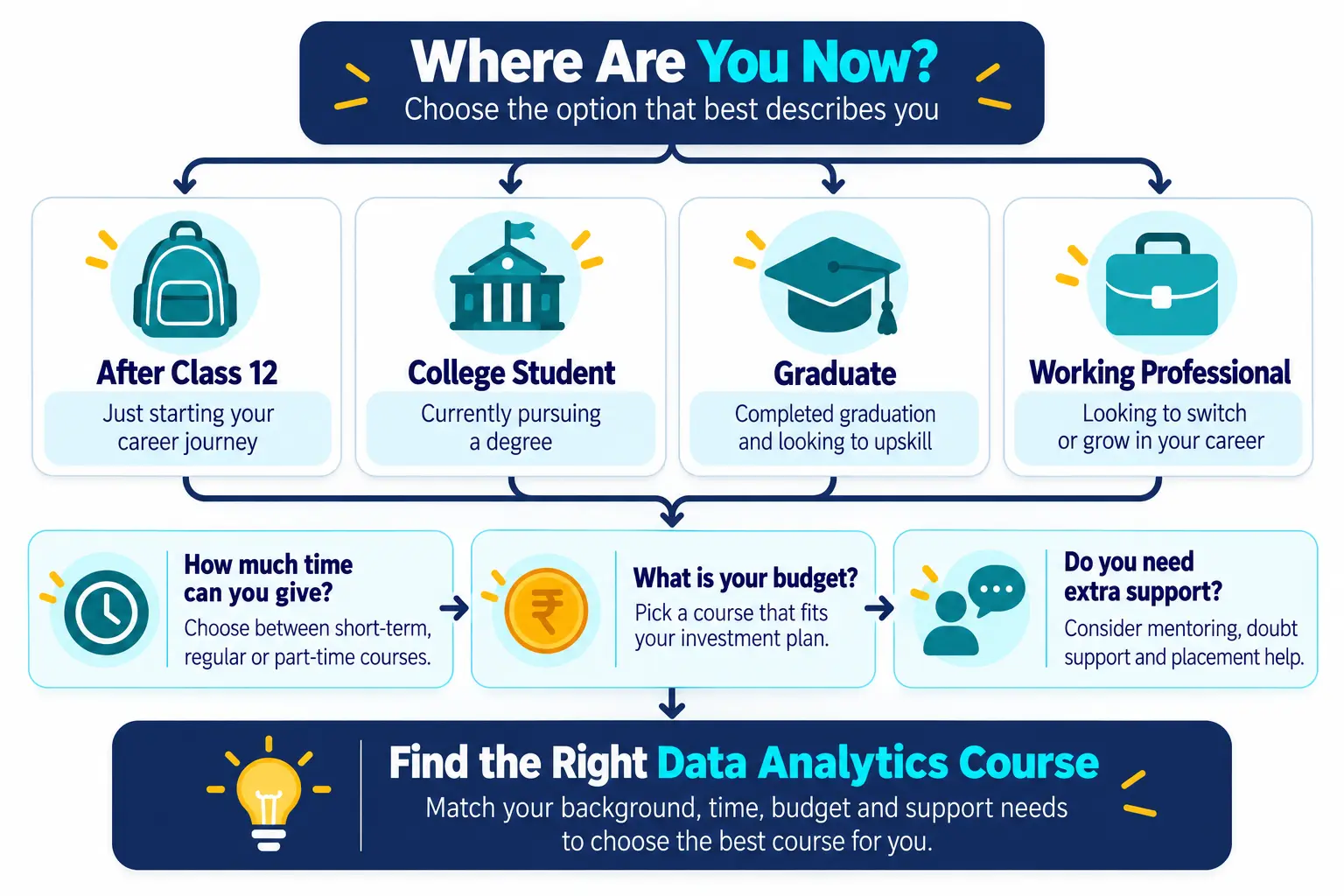
After Class 12
A short skills course can give you a head start, and some institutes, such as Karmick, accept students who have passed Class 12. Others, such as the St. Xavier’s diploma, are open only to graduates. Before you choose, read some entry-level analyst job listings and note how many ask for a degree. For many students, the practical route is to learn Excel and SQL alongside a degree rather than instead of one.
College students
Choose a part-time, weekend or online batch that fits around your classes. Start with Excel, statistics and SQL, and aim to finish two or three projects before your final year so you have a portfolio ready when you start applying.
Fresh graduates
A four-to-six-month course with projects and placement support is the most common route among the options we checked. If you want an academic credential and can commit a year, a university-linked diploma is another option. Compare the hours of live teaching, not just the duration.
Working professionals changing careers
Look for evening, weekend or live online batches with recordings. Your existing experience is an advantage: a finance or HR professional who learns analytics can apply it to data they already understand. Once you are comfortable with Power BI, you can also prepare for an industry exam such as Microsoft’s PL-300.
On a tight budget
Start with free resources to confirm your interest. Then pay for a mentored course when you know you want structured teaching, feedback on your projects and placement support.
Frequently asked questions
Q.1 Can I learn data analytics without a coding background?
Yes. Excel and Power BI need no programming, and most beginner courses start there. SQL uses a small set of English-like commands, and Python is usually taught later in the course. Several Kolkata institutes, including Webskitters Academy, DataSpace Academy and EME Academy, state that no coding background is required. What helps most is regular practice on real datasets.
Q.2 Can I do a data analytics course after Class 12?
Yes, some courses accept students who have passed Class 12. Karmick Institute, for example, lists 10+2 as its eligibility. Others are for graduates only, such as the St. Xavier’s postgraduate diploma. Check the eligibility for the specific course, and look at whether the jobs you want ask for a degree. Many students learn analytics alongside a degree in commerce, science, economics or another subject.
Q.3 How much does a data analytics course cost in Kolkata?
Published fees for the certificate courses we checked ranged from ₹35,000 to ₹1,07,000 on 13 October 2026, depending on the institute and plan. The one-year postgraduate diploma at St. Xavier’s College costs ₹95,000 plus a ₹600 registration fee. Always ask whether the quoted fee includes GST, certification and EMI charges.
Q.4 Can I learn data analytics in three months?
You can learn the basics of Excel, SQL and a dashboard tool in three months if you practise regularly, and some courses, such as Webskitters Academy’s, run for three to five months. Most courses compared here take six months. Google says many learners finish its Data Analytics Certificate in three to six months at under 10 hours a week. Being ready for a job also depends on finishing projects, not only on course length.
Q.5 Which data analytics course is best for beginners?
The best course is the one that matches your background, budget and schedule. Look for a course that starts with spreadsheets and statistics, teaches SQL and Power BI or Tableau before advanced topics, includes projects with trainer feedback and states its placement terms clearly. Compare two or three shortlisted courses using the tables in this guide.
Q.6 Does a data analytics course with placement guarantee a job?
Usually not. Most institutes offer placement assistance, which means help with your CV, interview preparation and job referrals. Getting a job also depends on your skills, projects, interview performance and the job market. If an institute offers a job guarantee, ask for the eligibility rules and refund terms in writing before you pay.
Next steps
Choosing a data analytics course is a big decision for a beginner, but it gets easier once you know what to compare. Shortlist two or three courses that match your budget, preferred format and background. Attend a demo class at each, ask the fee and placement questions above, and compare the answers in writing before you pay.
If EME Academy’s courses fit what you are looking for, you can book a free demo class or contact the admissions team to ask about batches and fees. Whichever institute you choose, the questions in this guide will help you make a decision you understand.

I am Ance John, a Content Writer with 6 years of experience in creating informative, engaging, and SEO-friendly content. I specialize in career guidance, education, professional development, digital marketing, and industry trends. My goal is to simplify complex topics and provide valuable insights that help students, freshers, and working professionals make informed career decisions. Through my content at Kolkata Skills, I focus on institute guides, career roadmaps, skill development, and educational opportunities in Kolkata.