Almost every data analytics course with live projects promises “real-world experience”. Open a few course pages and you will see the same words: live projects, capstones, case studies, internships. What they rarely tell you is what you will actually build, whose data you will use and what you can show an employer at the end.
This guide explains what “live project” usually means, the files a good project should leave you with, what Kolkata course pages actually list, and five portfolio projects you can build with or without a course.
The short answer: in most courses, a “live project” is a guided or capstone project on sample or public data that you complete and present yourself. Only a few involve a real organisation’s data. Either can be valuable if you build the whole thing, get feedback and can show the result. Before you enrol, ask to see a past learner’s finished project.
What “live project” means in a data analytics course
There is no standard definition. Institutes use “live”, “real-time”, “real-world” and “industry” projects to mean different things. The table below shows the five types you will usually come across.
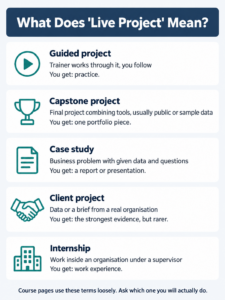
| What the course calls it | What it usually means | What you end up with | How to check |
|---|---|---|---|
| Guided project or exercise | The trainer works through a dataset and you follow step by step | Practice, but every learner has the same result | Ask whether you will also solve a similar problem on your own |
| Capstone project | A final project that combines several tools, usually on public or sample data | One complete portfolio piece | Ask to see two finished capstones from past learners |
| Case study | A business problem with given data and questions, written up with recommendations | A report or presentation | Ask whether you choose the questions or only answer fixed ones |
| Client or “live” project | Data or a brief from a real organisation | The strongest evidence of real work, but rarer | Ask who the client is, what you will build and what you are allowed to show afterwards |
| Internship | Work inside an organisation for a set period, under a supervisor | Work experience and an experience letter or certificate | Ask about duration, pay, supervisor and the actual tasks |
None of these is automatically better. A well-designed capstone on public data, which you build alone and present, can teach you more than a “client project” where a team of 20 learners each changes one chart. What matters is how much of the work you do yourself and what you can show afterwards.
Even well-known programmes use the simpler formats. The final course of Google’s Data Analytics Certificate is called “Complete a Case Study”, and it is designed to give learners a case study they can share with employers.
What you actually build: the files a project should leave you with
A complete analytics project follows the same path an analyst takes at work: a business question, data, cleaning, analysis, a dashboard and a recommendation. Each step leaves a file you can show.
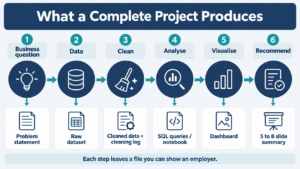
| Deliverable | Typical tool | What it shows an employer |
|---|---|---|
| A short problem statement | Word or a README file | You can turn a vague request into a clear question |
| A cleaned dataset with a cleaning log | Excel, Power Query or Python | You can handle messy data and explain your changes |
| A set of SQL queries | MySQL, PostgreSQL or SQL Server | You can pull and summarise data from a database |
| A dashboard | Power BI or Tableau | You can present data so others can act on it |
| An analysis notebook (optional) | Python with Pandas | You can work with larger data and automate steps |
| A 5 to 8 slide summary | PowerPoint or Google Slides | You can explain findings and recommend actions |
For dashboards, Microsoft’s PL-300 exam guide is a useful benchmark. It splits a Power BI analyst’s work into preparing data, modelling it, visualising and analysing it, and managing reports. If a course project only covers the visualising part, you are missing most of the job.
What Kolkata course pages list as projects
We checked what eight institutes that offer data analytics courses in Kolkata publish about their projects. Most were checked on 13 October 2026 and NICS Computer on 16 October 2026. This is what each page says, not an assessment of project quality.
| Institute (alphabetical) | Projects named on the course page | Real-client project mentioned? |
|---|---|---|
| DataMites (Kolkata page) | 10 capstone projects and 1 client or live project with an internship experience certificate | Yes, one client project |
| DataSpace Academy | Domain-based capstone projects, with an exam after each module | Not stated |
| EME Academy (Data Analytics Course) | Business analytics, sales forecasting, customer segmentation, financial data analysis and predictive modelling; a 1-month internship | Described as live projects; client not named |
| ExcelR (Kolkata page) | 20+ capstone projects and 30+ assignments in healthcare, banking, HR, energy, aviation and e-commerce | Not stated |
| Ivy Professional School | Amazon smartphone sales (Excel), an Airbnb Tableau dashboard and a Netflix/IMDB analysis (SQL) | Not stated |
| Karmick Institute | Capstone projects; its FAQ gives sales dashboards, customer churn and campaign reports as typical examples | Not stated |
| NICS Computer | A “Live Project (Real-World)” module: salary management system, sales and MIS dashboard, financial analysis report, automated Excel system | Not stated |
| Webskitters Academy | HR dashboards, sales reports, finance analytics and KPI reports; portfolio and capstone projects in its two higher plans | Not stated |
Two patterns stand out. First, only one page clearly mentions a real-client project; the rest describe capstones or business scenarios without naming a client. Second, the word “live” is used loosely. One institute labels a module “Live Project (Real-World)”, but the page does not say whether the work uses a real organisation’s data.
For fees, formats and syllabus details of these courses, see our comparison of data analytics courses in Kolkata.
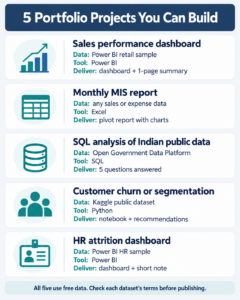
Five portfolio projects you can build, with or without a course
You do not need to wait for a course to start building. These five projects use free data and cover the skills Kolkata employers most often tag in their listings, as our guide to a data analytics career in Kolkata shows.
1. Sales performance dashboard
Question: which products, regions and months drive sales? Data: a retail sample from Microsoft’s Power BI samples or a public retail dataset. You deliver: a Power BI dashboard and a one-page summary of three findings.
2. Monthly MIS report in Excel
Question: how did this month compare with last month and the target? Data: any sales or expense dataset. You deliver: an Excel report with pivot tables, lookups and charts, laid out the way an MIS team would send it to a manager.
3. SQL analysis of Indian public data
Question: five specific questions about one topic, such as state-level indicators. Data: India’s Open Government Data Platform. You deliver: a file of SQL queries, each with the question it answers and the result.
4. Customer churn or segmentation analysis
Question: which customers are likely to leave, or which groups behave alike? Data: a public dataset from Kaggle. You deliver: a Python notebook with cleaning, analysis and a short list of recommendations.
5. HR attrition dashboard
Question: where and why are employees leaving? Data: the Human Resources sample in Microsoft’s Power BI samples. You deliver: a dashboard and a short note on what an HR manager should look into first.
A note on sample data: Microsoft’s terms say some of its Power BI sample data is fictitious, that any use must carry the credit “obviEnce ©”, and that the files are for internal reference. Read the terms before you publish a project built on them, and describe it honestly as built on sample data, not as a live or client project.
How to judge a data analytics course with live projects before you pay
Ask these questions during the demo or counselling call, and ask for the answers in writing where possible:
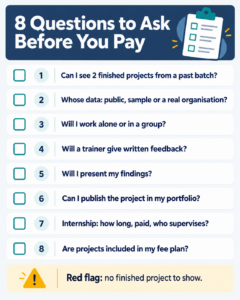
- Can I see two finished projects from a past batch, including the dashboard and the written summary?
- Where does the data come from: a public dataset, a sample file or a real organisation?
- Will I work alone or in a group, and how is my own contribution assessed?
- Will a trainer review my work and give written feedback before the final version?
- Will I present my findings, as I would to a manager?
- Can I publish the finished project in my portfolio, or is it covered by a confidentiality agreement?
- If there is an internship, how long is it, is it paid, and who supervises it?
- Are the projects included in the fee I am quoting, or only in a higher-priced plan?
The last question matters. Webskitters Academy, for example, lists portfolio and capstone projects in its two higher plans rather than its entry plan. Our guide on choosing a data analytics institute in Kolkata covers the other questions to ask.
Warning signs
- The institute cannot show any finished project from a past learner.
- “Live projects” are listed but no project, dataset or deliverable is described.
- The only proof of the project is a certificate.
- Projects are promised as a route to a guaranteed job.
How to show your projects to employers
- Write a short README for each project. Cover the problem, the data, your method, what you found and what you recommend.
- Add screenshots of your dashboard. Recruiters often skim before they open any file.
- Put the project on GitHub and LinkedIn. Link both from your CV.
- Describe the result, not just the tool. For example: “Built a Power BI dashboard that showed which three regions drove a fall in monthly sales.”
- Be ready to explain your choices. Interviewers often ask why you cleaned or charted the data a certain way.
- Respect data permissions. Never publish a client’s data without permission. Remove names and sensitive details if you are allowed to share the work.
Frequently asked questions
What is a live project in a data analytics course?
It is a hands-on project where you work through a business problem from question to recommendation, usually cleaning data, analysing it and building a dashboard or report. Most courses use sample or public data; a few use data from a real organisation. Ask the institute which type it offers.
What are the top 5 projects for data analysts?
Good beginner projects include a sales dashboard, a monthly MIS report in Excel, a SQL analysis of public data, a customer churn or segmentation analysis, and an HR attrition dashboard. Together they cover Excel, SQL, Power BI and Python.
What are the stages of a data analysis project?
There is no single official list, but most projects follow the same path: define the business question, collect the data, clean it, analyse it, visualise the results, and present a recommendation.
Can I do data analytics projects without joining a course?
Yes. You can use free data from India’s Open Government Data Platform, Kaggle or Microsoft’s Power BI samples. A course adds structure and feedback, but it is not the only way to build a portfolio.
Is a live project the same as an internship?
No. A live project is a piece of work, usually done inside a course. An internship means working for an organisation for a set period, under a supervisor. Some courses include both, so ask which one you will get and what certificate comes with it.
Do live projects guarantee a job?
No. Projects give you evidence of your skills and better interview answers, but getting a job also depends on your overall skills, how you present your work and the roles available. Be cautious of any course that links projects to a guaranteed job. Our guide to choosing an institute for placements explains what to ask.
Your next step
A data analytics course with live projects is worth paying for only if you leave with work you built and can explain. Start one of the five projects above this week, even before you choose a course. When you compare courses, ask to see finished projects and compare those, not the brochure.
Need help comparing courses or planning your portfolio? Contact the Kolkata Skills team.

I am Ance John, a Content Writer with 6 years of experience in creating informative, engaging, and SEO-friendly content. I specialize in career guidance, education, professional development, digital marketing, and industry trends. My goal is to simplify complex topics and provide valuable insights that help students, freshers, and working professionals make informed career decisions. Through my content at Kolkata Skills, I focus on institute guides, career roadmaps, skill development, and educational opportunities in Kolkata.