If you are searching for how to become a data analyst, most guides give you the same list: learn Python, learn SQL, build a portfolio. That advice is fine, but it skips what matters most to a student or job seeker in Kolkata. Which skills do local employers ask for? What can a fresher really expect? Where do you start if your degree is not in computer science?
This guide answers those questions in plain language. You will get a nine-step plan, a skills table, a 90-day schedule, project ideas with a Kolkata angle, salary ranges from named sources and a short readiness checklist you can use today.
Quick answer: Here is how to become a data analyst: learn Excel, SQL and one dashboard tool such as Power BI. Add basic statistics, then Python. Build three small projects and apply for data analyst, MIS and reporting roles. Many learners need around 3 to 6 months of regular practice. You do not need a computer science degree to start.
How we prepared this guide: We compared recent data analyst and MIS listings for Kolkata on job portals, salary pages from Payscale, and the learning paths published by Google and Microsoft. Where sources disagree, we show a range and name the source. We do not promise jobs or fixed salaries. You can read how we work in our editorial policy.
What Does a Data Analyst Do?
Before you learn how to become a data analyst, it helps to know the daily work. A data analyst turns raw numbers into answers that a business can act on. Imagine a retail chain with shops in Salt Lake and Park Street. Sales in one shop drop for two months. The analyst pulls the sales data, cleans it, compares it with other shops, finds the cause and shows it in a simple dashboard.
On a normal week, you may:
- Pull data from a database using SQL
- Clean duplicate or missing entries in Excel or Python
- Build a monthly report or dashboard
- Explain what changed, and why, to a manager in plain words
The last point is the one beginners forget. Good analysts are not only good with tools. They can explain a result clearly.
Is Data Analytics a Good Career in Kolkata?
Yes, with realistic expectations. Kolkata is a smaller analytics market than Bengaluru or Hyderabad, so there are fewer openings and more competition at entry level. Still, recent listings show data and reporting work across IT services, telecom, pharma, manufacturing and finance. Employers such as Accenture, TEOCO and Mendine Pharmaceuticals appeared in the listings we reviewed. These are examples, not a full hiring list.
Two things are worth knowing before you start:
- Many entry roles do not say “Data Analyst.” They say MIS Executive, Reporting Analyst or Data Operations Analyst, but the work is close to analysis.
- Many listings ask for 1 to 3 years of experience. That is why projects, internships and a small portfolio matter so much for freshers.
Who Can Become a Data Analyst?
There is no single data analyst eligibility rule, so how to become a data analyst depends on where you start. Many Kolkata listings simply ask for graduation in any stream. Degrees in statistics, maths, economics or computer science can help, but they are not the only door. Your current background decides where you should start.
| Your background | Your natural advantage | Start with | Possible first role |
|---|---|---|---|
| B.Com, BBA, accounting | Comfort with numbers and reports | Excel, then SQL | MIS Executive, Reporting Analyst |
| B.Sc (maths, stats, physics) | Statistics and logic | SQL, then Power BI | Junior Data Analyst |
| B.Tech, BCA | Coding basics | SQL, then Python | Data Analyst Trainee, Business Analyst |
| BA or other streams | Domain knowledge, writing | Excel, then Power BI | Data Operations, Research Analyst |
| Working professional (sales, HR, operations) | Business context | Excel and Power BI on your own work data | Analyst role in your current company |
| Class 12 student | Time to build skills early | Excel basics and free practice during graduation | Internships after year two or three |
Skills You Need to Become a Data Analyst
If you are wondering how to become a data analyst, start with skills. These are the data analyst skills that appear again and again in job listings and learning roadmaps. Learn them in this order.
| Skill | What you will use it for | Beginner target |
|---|---|---|
| Excel | Cleaning data, pivot tables, XLOOKUP, charts | Build a monthly sales report from raw data without help |
| SQL | Pulling and joining data from databases | Answer five business questions using only SQL |
| Power BI or Tableau | Dashboards and visual reports | Build one dashboard with filters and clear charts |
| Statistics | Averages, spread, correlation, sampling | Explain a result to a non-technical person in two minutes |
| Python (Pandas) | Cleaning and analysing larger files | Clean a CSV file and summarise it in a notebook |
| Communication | Presenting findings | Write a one-page summary of a project |
Python helps, but it is not required for every entry-level role. Excel, SQL and a dashboard tool give you the widest set of openings first.
How to Become a Data Analyst in 9 Steps
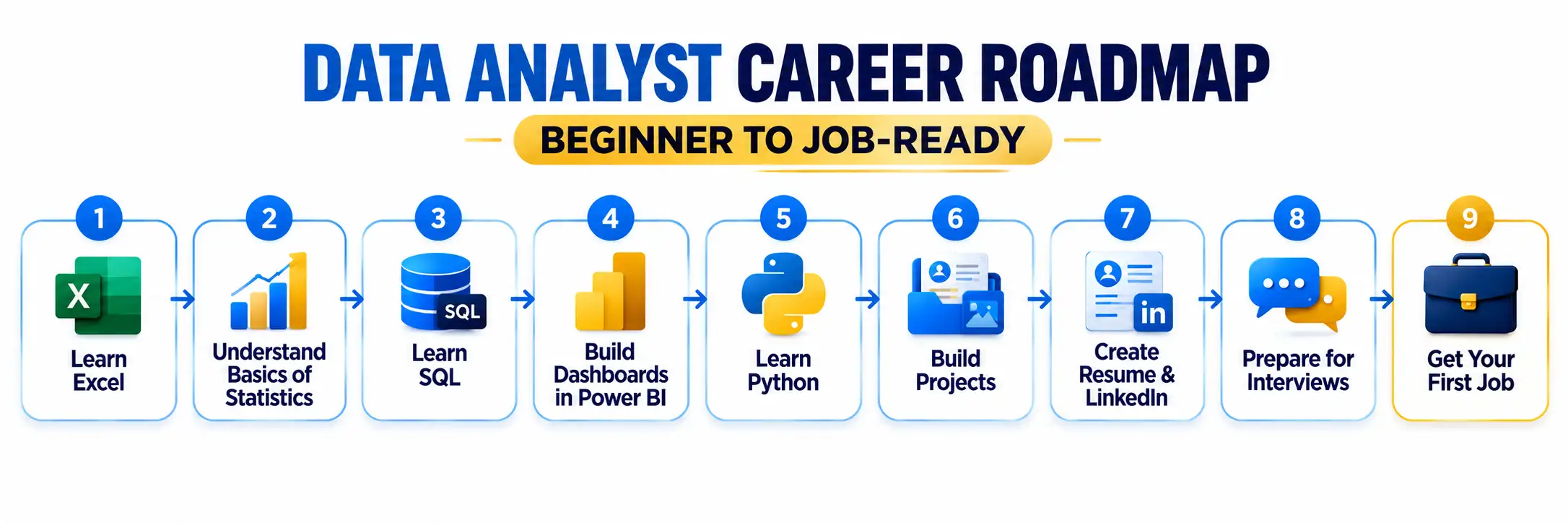
Follow these steps in order. Each one builds on the last, and each ends with something you can show to an employer.
Step 1: Understand the role and pick your lane
Data jobs have many names. A data analyst answers business questions with data. A business analyst works closer to requirements and clients. An MIS executive prepares regular reports, mostly in Excel. A data scientist builds prediction models and needs deeper maths and coding.
For most beginners, the analyst or reporting lane is the realistic start. You can grow towards data science later. This weekend, read ten Kolkata data analyst listings and note which tools repeat. That list becomes your study plan.
Step 2: Get strong at Excel first
Excel is where many Kolkata analysts begin, and many MIS roles live in it. Learn formulas, XLOOKUP or VLOOKUP, pivot tables, conditional formatting and charts. Practise on messy files, not neat tutorial sheets. Try the same tasks in Google Sheets too, because some listings ask for it.
Step 3: Learn basic statistics
You do not need advanced maths. You need mean, median, standard deviation, percentiles, correlation and the idea of a sample. Learn to read a distribution and spot outliers. This protects you from wrong conclusions, such as calling a trend real when it is just noise.
Step 4: Learn SQL
SQL is how you pull data from a database. Start with SELECT, WHERE, GROUP BY, ORDER BY and JOIN. Move on to subqueries and window functions. SQL questions show up in most analyst interviews, so practise a little every day. Free sample databases are enough to start.
Step 5: Learn Power BI or Tableau
Dashboards turn analysis into something a manager can use. Pick Power BI first. It appears often in Kolkata listings and its desktop version is free. Learn to load data, clean it in Power Query, build relationships, write simple measures and add filters.
Microsoft’s PL-300 study guide lists what a Power BI analyst should know. It works as a handy checklist even if you never take the exam.
Step 6: Add Python when you are ready
Do not start with Python. Add it after Excel, SQL and one dashboard tool. Begin with Pandas for cleaning, grouping and simple charts. Python becomes useful when files get too big for Excel or when you want to repeat the same cleaning steps often.
Step 7: Build three portfolio projects
When most listings ask for experience, projects are your proof. Aim for three complete projects, each answering one business question. The project ideas below will help you choose.
Step 8: Prepare your resume and LinkedIn
Put your skills and projects at the top. Give each project one line with a result, for example “Built a Power BI dashboard that compared monthly sales by region.” Use the same job-title words that you see in listings. Keep the resume to one page and list only tools you can actually use.
Step 9: Apply smartly and prepare for interviews
Apply for data analyst, MIS, reporting and business analyst roles, plus internships. If a listing asks for 0 to 2 years and you match the core skills, apply anyway. Practise four things before interviews: SQL joins, explaining one project end to end, handling missing data and reading a chart out loud.
Your 90-Day Plan to Become a Data Analyst
This plan turns the nine steps into a calendar. It assumes 1 to 2 hours a day. If you are studying and working, stretch it to four or five months. It is a suggested schedule, not a rule.
| Days | Focus | What you should have at the end |
|---|---|---|
| 1 to 21 | Excel (formulas, pivots, charts) | A monthly sales report built from raw data |
| 22 to 35 | Basic statistics | A one-page summary of a dataset with averages, spread and outliers |
| 36 to 60 | SQL | Five business questions answered with queries |
| 61 to 80 | Power BI | One dashboard with filters |
| 81 to 90 | Project and resume | One published project and a one-page resume |
After day 90, add Python, build two more projects and start applying. You can apply earlier if your first project is ready.
Portfolio Project Ideas with a Kolkata Angle
Recruiters see the same Titanic and Iris datasets in every portfolio. Projects with a local business question stand out more. Where real data is not available, create clearly labelled sample data and say so in your write-up.
| Project | Business question | Tools |
|---|---|---|
| Festival season sales dashboard | Which product groups rise before Durga Puja, and which months are slow? | Excel, Power BI |
| Monthly MIS report for a sample company | Which branch missed its target, and by how much? | Excel pivot tables |
| Local price comparison | How do prices of one item differ across areas of the city? | SQL, Power BI |
| Clinic appointment pattern | Which hours are busiest, and when do patients not show up? | Excel or SQL |
Public datasets are available on India’s Open Government Data Platform. For each project, write a short case study with five parts: the question, the data, your method, what you found and what you would suggest. Share it on GitHub or LinkedIn so recruiters can open it in one click.
Job Titles to Search for in Kolkata
Searching only for “Data Analyst” hides many openings. Try these titles too.
| Job title | What it often involves | Good starting point for |
|---|---|---|
| Data Analyst or Junior Data Analyst | SQL, dashboards, business questions | Learners with SQL and Power BI |
| MIS Executive or MIS Analyst | Excel or Google Sheets reports | Freshers and commerce graduates |
| Reporting Analyst or BI Analyst | Power BI or Tableau dashboards | Learners with strong dashboard skills |
| Business Analyst | Requirements plus data analysis | Candidates with good communication |
| Data Operations or Data Quality Analyst | Checking and cleaning data | Entry-level applicants |
If you want to see which institutes teach these tools, our guide to data analytics courses in Kolkata for beginners compares them side by side.
Data Analyst Salary in Kolkata
Salary pages rarely agree, so read them as ranges. Here is what Payscale showed for Kolkata when we checked in October 2026.
| Payscale page (Kolkata) | Average base salary | Note |
|---|---|---|
| Early-career Junior Data Analyst | About ₹3.83 lakh a year | Middle half of salaries: about ₹2.85 to ₹4.5 lakh |
| Early-career Data Analyst with Power BI skills | About ₹4.98 lakh a year | Different job-title group, so not a direct comparison |
| Early-career Data Analyst with Tableau skills | About ₹5.37 lakh a year | Different job-title group, so not a direct comparison |
Other career blogs quote a fresher range of about ₹3 to ₹5.5 lakh for Kolkata. Treat that as a rough guide, not a promise. Pay depends on your skills, your projects, the employer and how well you do in interviews. The tables above suggest that dashboard and SQL skills can move you towards the upper end, but ask each employer for the exact range before you accept an offer.
Courses and Certificates: Do You Need Them?
How to become a data analyst is not only a question of paid courses. You can learn everything above on your own. A structured course helps if you need a fixed schedule, feedback on your projects and a group to learn with. A certificate alone does not get a job, but a clear learning path can keep you consistent.
Two well-known options are the Google Data Analytics Certificate and Microsoft’s Power BI Data Analyst certification (PL-300). Google says many learners finish its certificate in three to six months at under 10 hours a week.
If you plan to join a Kolkata institute, read how to choose a data analytics institute in Kolkata first. Then ask for written answers to these questions:
- How many learners from the last batch got analyst roles, out of how many enrolled?
- What does placement support include, and who is eligible?
- Will a trainer review my projects?
Our guide to institutes with placement support explains these questions in more detail.
A Closer Look at One Kolkata Option: EME Academy
The details below come from EME Academy’s website and were checked on 17 October 2026. They are the institute’s own statements, and fees and batches can change. Please confirm them with the institute.
To make this guide practical, here is how one Kolkata institute, EME Academy, structures its data analytics course. Use it as a reference point when you compare any institute.
| Detail | What EME Academy lists |
|---|---|
| Course duration | 6 months |
| Fee | ₹35,000 (listed price ₹45,000 before the discount), with 0% EMI |
| Tools taught | Excel (basic and advanced), MySQL, Tableau, Power BI, business statistics, Python, LLM and ChatGPT basics, SAS (self-paced) |
| Mode | Classroom and online |
| Languages | Bengali, English and Hindi |
| Campus | Globsyn Crystals, Bidhannagar, Kolkata 700091 |
| Demo class | Free demo classes offered |
| Roles listed | Data Analyst, Marketing Analyst, Data Visualization Specialist, BI Analyst |
How the syllabus compares with this guide. The core tools (Excel, SQL through MySQL, Power BI, statistics and Python) match the skills table above. Tableau, LLM basics and self-paced SAS are extras. They can be useful, but they are not what most entry-level listings ask for first.
What it says about placement. EME Academy lists resume and LinkedIn help, aptitude training, interview practice, mentorship, portfolio building and a hiring network. It describes this as “100% placement assistance” and says it supported more than 750 placements in the last year. These are marketing figures from the institute, and we could not verify them independently. The course page also does not define what “assistance” includes or who qualifies.
A balanced view. Here is how we would weigh it:
| Points that may help you | Points to confirm before you pay |
|---|---|
| Fixed schedule and mentor feedback, which suit learners who struggle with self-study | Full syllabus and batch timings (not listed on the course page when we checked) |
| Classes in Bengali, Hindi and English | Whether an internship is included (the page does not say) |
| 0% EMI and a lower listed fee than many classroom courses | Placement terms in writing, plus the latest batch report |
| Free demo class before you decide | Certification details and who issues them |
This checklist applies to any institute, not only this one. Attend a demo class, ask for the syllabus, read recent Google reviews and compare at least two or three options. EME Academy shows a 4.8 Google rating on its website, so check the live listing yourself. For details, visit the course page or call 9831284098.
Are You Ready to Apply? A 10-Point Checklist
Give yourself one point for each statement that is true today.
- I can build a pivot table and a chart in Excel without a tutorial.
- I can use XLOOKUP or VLOOKUP correctly.
- I can explain the difference between mean and median with an example.
- I can write a SQL query with a JOIN and a GROUP BY.
- I have built one dashboard with filters in Power BI or Tableau.
- I have finished at least two projects with a written summary.
- My projects are public on GitHub or LinkedIn.
- My resume fits on one page and matches the listings I want.
- I can explain one project in two minutes without reading notes.
- I have applied to at least five roles or internships.
| Score | What it means |
|---|---|
| 0 to 3 | Focus on skills. Follow the 90-day plan from the start. |
| 4 to 7 | You are close. Finish your projects and start applying for internships and MIS roles. |
| 8 to 10 | Apply widely and practise interviews every week. |
Common Mistakes Beginners Make
- Learning too many tools at once. Master Excel, SQL and one dashboard tool before you add more.
- Collecting certificates without projects. A certificate shows you finished a course. A project shows you can do the work.
- Skipping MIS and reporting roles. They are a practical first step and build good reporting habits.
- Using only famous datasets. Local, clearly explained projects are easier to remember.
- Trusting one salary number. Check the source, the sample size and the date.
- Believing job guarantees. Ask for placement terms in writing before you pay for any course.
Frequently Asked Questions
Q.1 How to become a data analyst with no experience?
Start with Excel, SQL and Power BI. Build two or three projects using public or sample data, and publish them online. Then apply for internships, MIS roles and junior analyst roles. Your projects act as proof of experience until you get your first job.
Q.2 What qualification is needed to become a data analyst?
There is no single rule. Many listings ask for graduation in any stream, while degrees in maths, statistics, economics or computer science can help. Employers mostly look at your tools, your projects and how clearly you explain your work.
Q.3 Can a non-IT graduate become a data analyst?
Yes. Commerce, science and arts graduates all move into analytics. Your subject knowledge can be an advantage because you already understand how a business or field works. Begin with Excel and SQL, then add Power BI.
Q.4 How long does it take to become a data analyst?
For most people, how to become a data analyst is a matter of months, not years. Many learners need around 3 to 6 months of regular practice to be ready for entry-level roles. The time depends on your background, daily study hours and how many projects you finish. A full-time job will stretch the timeline.
Q.5 Do I need to learn coding to become a data analyst?
You need SQL, which is a simple query language. Python is useful but not required for every entry-level role. Learn Excel, SQL and a dashboard tool first, then add Python when you are comfortable.
Q.6 What is the fresher salary of a data analyst in Kolkata?
Payscale pages for Kolkata show an average of about ₹3.83 lakh a year for early-career junior data analysts and about ₹4.98 lakh for early-career analysts with Power BI skills. Offers vary by employer and skills, so ask for the range before you accept.
Q.7 Which is the best institute for a data analyst course in Kolkata?
There is no single best institute. The right one depends on your budget, schedule and background. Compare syllabus, trainer feedback, project work and placement terms for two or three options, such as EME Academy, and attend a demo class before you decide.
Q.8 Is data analyst a good career in Kolkata?
It can be a good career if you prepare for the local market. Kolkata has fewer openings than the biggest tech cities, but there is demand across IT services, pharma, finance and manufacturing. Skills and projects improve your chances.
Q.9 Can AI replace data analysts?
AI tools can help you write formulas and queries faster, but they do not understand your business question on their own. Analysts still need to check results, spot errors and explain findings clearly. Learning to use AI tools well is a useful skill.
Final Thoughts
Learning how to become a data analyst is less about one big course and more about steady practice. Start with Excel, add SQL and Power BI, build three honest projects and apply for roles beyond the “Data Analyst” title. Your first job may be an MIS or reporting role, and that is a good start.
Now you know how to become a data analyst in Kolkata, the next move is yours. If you decide to join a course, compare a few institutes first. Not sure which path fits your background? Read more career guides on the Kolkata Skills blog, or talk to the Kolkata Skills team for free career guidance.

I am Ance John, a Content Writer with 6 years of experience in creating informative, engaging, and SEO-friendly content. I specialize in career guidance, education, professional development, digital marketing, and industry trends. My goal is to simplify complex topics and provide valuable insights that help students, freshers, and working professionals make informed career decisions. Through my content at Kolkata Skills, I focus on institute guides, career roadmaps, skill development, and educational opportunities in Kolkata.